

Vinyl record grading scale: M, NM, VG+, and G explained
· 11 min read
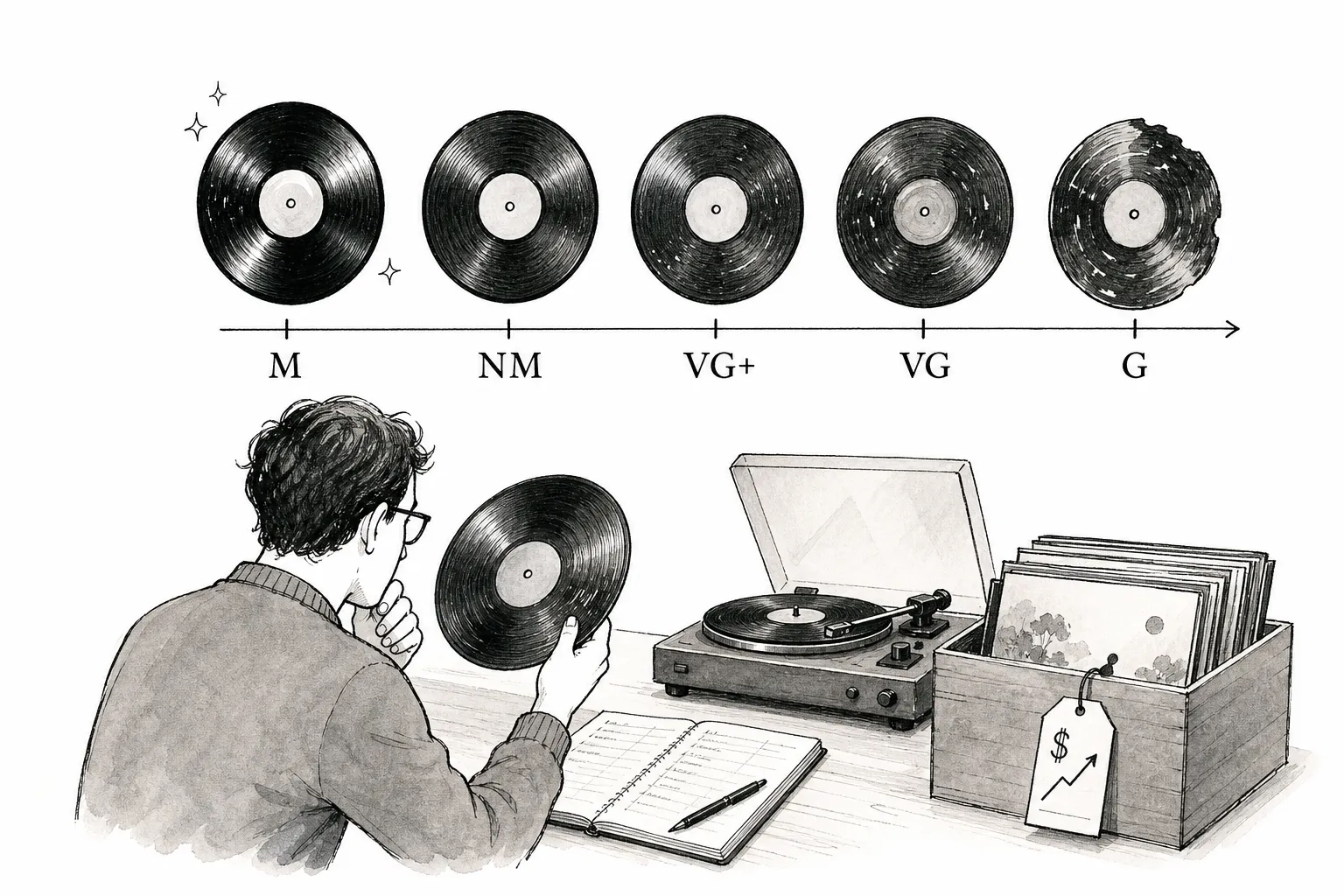
You're browsing a listing for a record you've wanted forever. The price looks fair. Then you see it: "VG+." You think, okay, that sounds... positive? But then you spot another copy listed at "NM" for twice the price, and a third one at "VG" for almost nothing. Suddenly you're second-guessing everything. That's exactly where the record grading scale comes in, it's the shared language collectors, dealers, and marketplace platforms use to communicate condition, and once you learn it, every listing becomes readable in seconds.
Here's the good news: the record grading scale isn't a secret code. It's a consistent, learnable system built on a single foundation called the Goldmine Standard, which has been the backbone of how the collecting world communicates record condition for decades. Once you internalize the logic, you'll read any listing with confidence and never overpay for a surprise crackle-fest again.
This article walks through every official grade, what each one looks and sounds like, how Discogs builds on the Goldmine Standard, why your sleeve gets its own grade, and typically how much each grade drop costs you at checkout, though exact prices vary by pressing, demand, and seller. By the end, you'll have a practical inspection checklist and a clear sense of what you're actually buying.
The full record grading scale, from perfect to player copy
The grades at a glance
The Goldmine Standard runs eight grades from best to worst: Mint (M), Near Mint (NM), Very Good Plus (VG+), Very Good (VG), Good Plus (G+), Good (G), Fair (F), and Poor (P). True Mint exists almost exclusively on sealed, unplayed copies. In practice, NM is the top of the scale you'll realistically encounter in the wild. VG+ goes by a second name too: Excellent, or EX. Both labels mean exactly the same thing, so don't let the alternate abbreviation throw you off. For a deeper primer on how collectors compare grading scales you can read an overview of the differences between vinyl record grading scales.
  Grade
  Abbreviation
  Audible Character
  Typical Price vs. NM


  Mint
  M
  Dead silent; sealed/unplayed
  100%+


  Near Mint
  NM
  Essentially silent between tracks
  100% (reference)


  Very Good Plus / Excellent
  VG+ / EX
  Near-silent; minor surface noise
  ~50%


  Very Good
  VG
  Audible crackle in quiet passages
  ~25%


  Good Plus / Good
  G+ / G
  Constant noise floor; heavy wear
  ~10, 15%


  Fair
  F
  Distortion; unpredictable skipping
  ~5% or less


  Poor
  P
  Barely playable; display or parts only
  ~5% or less
What "Good" actually sounds like (spoiler: not great)
This is the biggest misconception in record collecting, and it trips up beginners constantly. "Good" does not mean good. A VG record has constant audible crackle, light scratches you can see without tilting the record, and measurable groove wear. It's what collectors call a player copy: something you spin casually, not something you treasure. G and G+ are rougher still, worth buying only when the music matters more than fidelity. Fair and Poor are worse, records at those grades skip, distort, and sometimes repeat grooves. They're essentially display pieces or parts copies at that point.
Sonic reality at each grade
Here's an honest audio breakdown. NM and VG+ are typically silent between tracks, with the music coming through clean and full, though perceived noise does vary depending on your playback equipment, cartridge condition, and how sensitive your ears are. VG commonly introduces crackle in quiet passages and soft intros, most noticeable during fades. G and G+ layer a constant noise floor over the music, like listening through a light static haze. F and P distort on louder passages and skip unpredictably. Buying a G record for serious listening is a gamble; buying one for a casual spin of a beloved album is often a perfectly reasonable call. For another accessible explanation of what NM, VG and G mean in practice see this guide to understanding vinyl record grades.
Goldmine vs. Discogs standards: where they agree and where they differ
Why Discogs uses the same scale but feels different
Discogs officially adopts the Goldmine Standard for its Marketplace, so the grades themselves are identical. What Discogs adds is a layer of community-driven refinement built around practical listing needs. That includes explicit grading rules for CDs (which Goldmine doesn't address in detail) and a "generic sleeve" category for plain company sleeves that don't require their own condition grade, since they're easily replaced and carry no collectible value. Discogs documents these listing and grading practices in their help center, see the Discogs grading help pages for details.
The "Excellent" grade and the visual vs. play grading problem
Some sellers on Discogs insert "Excellent" (EX) between NM and VG+ to create finer nuance, even though it isn't part of the official Goldmine list. This isn't wrong exactly, just unofficial. The more important distinction to understand is visual versus play grading. Goldmine grading ideally involves playback verification, but the vast majority of Discogs sellers grade by sight alone under a direct light source, a practice well-documented in Discogs' own help pages and seller community. Assume every listing is visually graded unless the seller explicitly states "play graded." That means a VG+ listing could still surprise you sonically, which is why detailed condition notes and photos matter so much.
Why the sleeve gets its own grade (and how to report both)
Record and sleeve condition tell two different stories
A cover can spend 40 years getting shuffled in and out of a crate while the vinyl inside stays nearly perfect. The reverse happens too: a sleeve in great shape can hide a record that's been played to death. A single combined grade would mislead any buyer, so both components get graded separately. Cover flaws have their own progression: NM sleeves are crisp with no creases or ring wear; VG+ allows a small seam split, typically under roughly one inch, per Goldmine guidance; VG shows obvious ring wear, multiple creases, or writing; G means the cover is struggling to hold the record inside.
How to list (and read) mixed grades honestly
The correct format is simple: list both grades as separate line items. "Record: NM / Sleeve: VG" tells the buyer exactly what they're getting. Averaging the two into a single grade is discouraged because it masks which component is the weak link. A near-perfect record in a beat-up sleeve is a very different purchase than two mediocre components that average to the same number. For generic sleeves, skip the grade entirely and just note it's a plain company sleeve in the condition comments. Photos of both sides of the cover, both labels, and any notable flaws are the clearest communication you can offer.
A practical inspection checklist for the record grading scale
What to look at on the vinyl surface
Hold the record at an angle under a direct light source, a bright lamp or a cleaning station light works perfectly. You're looking for four things: hairline scratches, which are often inaudible but worth noting; deep scratches that catch your fingernail, which will make noise; scuffs from sleeve removal, which cause light surface hiss; and groove wear on dynamic passages, which shows up as a dull, gray appearance in the grooves rather than clean, shiny vinyl. Also check for warps by laying the record on a flat surface and looking across the face. Check the label too: spindle marks, writing, and tears all factor into the grade.
A quick decision guide for what triggers a grade drop versus what's cosmetic: hairlines that don't catch a fingernail are cosmetic; anything you can feel means a grade drop. A single seam split under roughly one inch keeps a sleeve at VG+ (per Goldmine's standard threshold); multiple splits or splits longer than that drop it to VG or below.
What to check on the cover
Work through this list on every cover you inspect:
- Seam splits: measure and note the length on top, bottom, and spine separately
- Ring wear: the circular impression the record leaves on the cover front from storage pressure
- Spine wear: fading, splitting, or scuffing along the spine from shelf life
- Stickers, writing, or tape residue anywhere on the exterior
- Corner dings or bends
- Water stains or moisture damage, which can wrinkle the cardboard and sometimes transfer mold to the vinyl
Multiple small issues compound into a lower grade even when no single flaw is severe on its own. A sleeve with light ring wear, one small corner ding, and minor spine fading might individually seem fine, but together they push it from VG+ to VG. Document everything with photos and you'll never have a dispute with a buyer. For a step-by-step grading walkthrough you may also find a dedicated vinyl record grading guide helpful when you first practice grading at home.
How condition grades move the price tag
The 50% rule most beginners don't know
The Goldmine Standard establishes specific price percentages relative to NM, and they're steeper than most people expect. Based on Goldmine pricing guidelines and typical Discogs sale data, VG+ is worth approximately 50% of the NM price. VG drops to roughly 25% of NM. G and G+ settle around 10 to 15%. These are common market approximations rather than fixed rules, actual prices shift with pressing rarity, demand, and seller. To make that concrete: a pressing worth $80 in NM condition typically sells for around $40 at VG+, around $20 at VG, and under $12 at G. Every grade drop is a direct multiplier on value, not just a quality descriptor. That's why knowing how to read the record grading scale accurately before you buy is worth the five minutes it takes to inspect.
When buying below VG+ makes sense
Not every purchase needs to be NM. There are clear situations where a lower grade is a smart call: filling a gap in your collection with a hard-to-find pressing that rarely comes up for sale, grabbing a casual listening copy of a favorite album before you commit to hunting a clean one, or testing out an artist you've never heard before spending real money. The cases where condition matters most are audiophile listening setups, resale intent, and rare pressings where the NM premium is justified because a downgraded copy is genuinely hard to unload later.
Seeing condition and rarity together in one place
Why condition grade alone doesn't tell the whole value story
A record graded NM is only half the picture. Its actual value also depends on how scarce the pressing is: how many copies exist versus how many collectors want them. Two NM records at identical grades can sit at completely different price points based on pressing scarcity alone. Serious collectors track both condition and rarity, not just one or the other, because the combination is what actually determines what a record is worth and how hard it'll be to find again if you pass on it. If you want to learn more about spotting rare pressings, read how to tell if a vinyl record is rare.
How VinylDeck brings condition and rarity into one view
Tracking condition grades is only step one. VinylDeck is built for collectors who want both dimensions, condition and rarity, visible on a single card without toggling between tabs or cross-referencing spreadsheets. You assign a condition badge when you add a record to your catalog, and the platform layers in rarity context drawn from Discogs market data, so you can see the full picture of what each record in your collection is actually worth. For collectors who've just learned to grade consistently, it's a natural next step: catalog what you know, and let the data fill in the rest.
Start grading with confidence using the record grading scale
The record grading scale is a consistent language. Once you know the definitions, every listing becomes readable in seconds. Three things to keep front of mind: condition and sleeve are always graded separately, "Good" is not good, and every grade drop cuts value significantly. Those three rules alone will save you money and frustration on your next purchase.
Run your collection through the inspection checklist the next time you're at your shelves. You'll likely find a few records you've been mentally upgrading for years and a few sleeves that deserve a closer look. Getting accurate with your own grades makes you a better buyer and a more trustworthy seller.
Once you've got your grades dialed in, VinylDeck, your vinyl collection, graded like a card deck is ready when you are. Drop a condition badge on each card, see how your collection stacks up across both condition and rarity, and get a complete picture of what's sitting on your shelves. Give it a try and start building the catalog your collection deserves.