

The Vinyl Pressings Collectors Hunt Most: A Deep Dive
· 10 min read
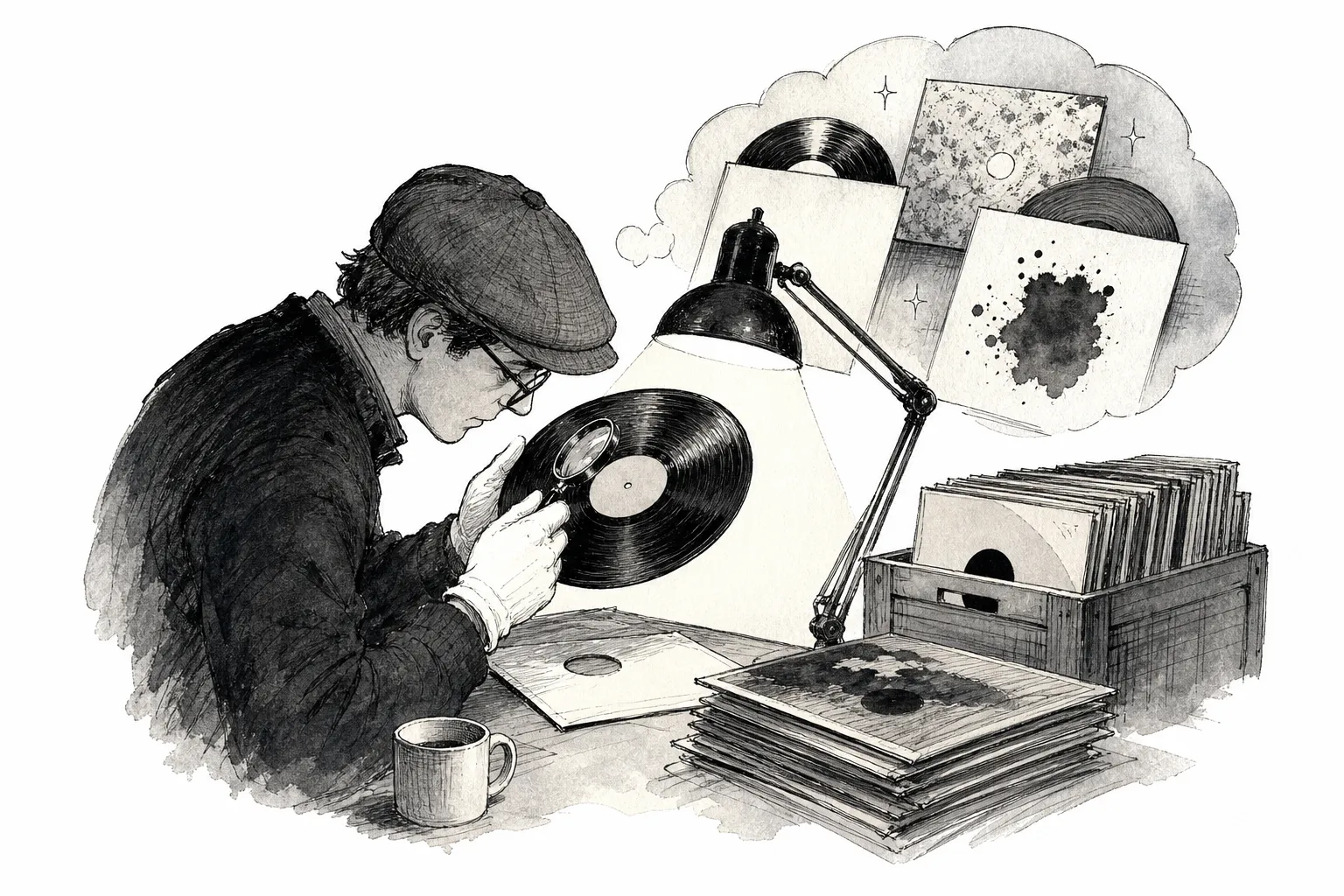
Two copies of the same album sit side by side at a record fair. One is worth $4. The other just sold for $4,500. Nothing on the cover tells you which is which. That gap, invisible to most people walking past, is exactly what makes vinyl hunting one of the most intellectually demanding collector hobbies alive. Which record pressings do collectors hunt the most? The answer lives in details most buyers never learn to read: dead wax etchings, pressing plant codes, label colors, and scarcity data that separates a bargain bin find from a genuine grail.
This guide breaks down the pressings serious collectors chase most: what they are, why they command serious money, how to identify them before someone else does, and where to find them without getting burned. Whether you've been digging crates for a decade or you're trying to understand why a certain copy of Bleach costs more than a plane ticket, this is the framework that changes how you see every record on your shelf. VinylDeck users are already surfacing these insights at scale, with live rarity grades pulled from real market data rather than guesswork, but the knowledge behind those grades is worth understanding yourself.
Why certain pressings become collector obsessions
Collectors aren't paying for music when they chase a first pressing. They're paying for a specific moment in manufacturing history that can never be re-created, only replicated. This is the core of the scarcity paradox: a reissue can sound identical, look nearly identical, and still be worth a fraction of the original because the original is irreversible. The plate, the plant, the moment, the pressing run, all of it existed once, and once that window closed, it closed permanently. For a clear comparison of first pressings versus later reissues and why that premium exists, see First Pressing Vinyl vs Reissues.
The most honest signal in the vinyl market is the Discogs have/want ratio: how many collectors own a specific pressing versus how many want it. A low have count against a high want count is the mathematical definition of a grail. A pressing with 200 owners and 1,400 wanting it tells you something no seller's description ever will. VinylDeck's five-tier rarity system (Common through Grail) is built directly on this live data, giving collectors an instant visual grade for any pressing in their library rather than doing the math manually on every single release.
Which record pressings do collectors hunt the most: first pressings and originals
The most important identification skill a collector can develop is reading the dead wax, the smooth area between the label and the grooves where manufacturing codes are etched. (If you want a concise primer on matrix codes and how to read them, see what matrix codes mean.)
Reading the dead wax
Codes like "A1 B1" or "A//1 B//1" signal the original master plates. A suffix of "-2" or "-3" indicates a later run. Mastering engineer stamps or hand-etched initials in that same area are additional signals that most people walk right past without noticing. This information is the record's fingerprint, and it's right there on every copy if you know where to look. For a step-by-step look at how to identify a first pressing from runout and label clues, check how to tell if a record is a first press.
Label and packaging tells
Beyond the dead wax, original pressings carry a constellation of physical tells. Original label colors and fonts differ from later versions, and pre-1980 originals typically lack barcodes entirely. Laminated covers versus matte finishes and inner sleeve advertising content both point toward or away from an original. So do mismatches between the ℗ and © years: a ℗ dated 1969 on a record with a 1974 label means you're holding a repress, not the real thing.
The premiums these details command are not trivial. The 1967 UK mono Sgt. Pepper's in excellent condition trades between $500 and $2,000. The original UK Led Zeppelin I with turquoise lettering fetches $800 to $1,500 in VG+ condition against reissues selling for $25 to $50, a premium exceeding 3,000%. The original Velvet Underground pressing with an intact banana sticker trades at $1,300 to $3,200. Miles Davis's Kind of Blue in original mono "six eye" Columbia pressing brings $500 to $1,200. These are documented Discogs and auction transactions, not collector mythology.
Mispressings, factory errors, and promos: when mistakes become money
Factory errors become valuable for a simple reason: quality control catches and destroys almost every mistake. Surviving copies are rare by definition. The more significant the error and the more significant the album, the higher the premium, because the overlap between "historically important release" and "factory-destroyed rarity" produces a very small set of surviving copies.
The documented examples make the point clearly. Bob Dylan's The Freewheelin' Bob Dylan in the rare stereo pressing with four withdrawn tracks, including "Talkin' John Birch Blues", sold for $150,000 in 2022. Only a small batch escaped destruction after Columbia recalled them. The Beatles' White Album numbered #0000001, Ringo Starr's personal copy, sold for $790,000 at Heritage Auctions. Prince's The Black Album in the A&M pressing, one of roughly 25,000 copies pressed before the recall, with most destroyed, fetches over $15,000 for verified originals. Even smaller errors carry real market value: a misspelled "Norwegian Wood" on a white Apple label from 1987 trades at $500 to $750 in good condition. The pattern holds consistently: the more significant the original release, the more a surviving error copy is worth.
Standard promos are rarely as valuable as collectors expect. The real exceptions are early test pressings of iconic albums, sometimes only five to twenty copies were made, and promos with genuinely unique labels from landmark releases, such as a white-label test pressing of a debut that went on to define a genre. Most generic promotional copies add modest premiums at best.
Limited editions, color variants, and the geography of pressing value
The country and plant of origin matter more than most casual collectors realize. Early UK Parlophone and HMV facilities produced the pressings most closely tied to the first runs of British Invasion-era records. The black label with yellow Parlophone logo is one of the most recognizable markers of a genuinely early Beatles pressing. US plants like RCA Victor's subsidiaries left their own matrix signatures in the dead wax. Collectors identify specific plants from codes etched into the runout groove: Plastylite's association with pre-1966 Blue Note pressings in New Jersey, Presswell's "PR" marks, Terre Haute's "CT" or "73" codes, and Rockaway's small stamped "r."
Genre and era narrow the target window considerably. Original Blue Note and Prestige jazz pressings from the late 1950s through mid-1960s are in a class of their own: a mint John Coltrane Blue Train on Blue Note 1577 brought $12,600 at auction. The same title as a reissue on Discogs sells for $3 to $30. That is not a typo. The gap between originals and reissues in this genre runs from 20x to 4,000x depending on title and condition. Classic rock pressings from the late 1960s to early 1970s follow similar patterns, with Pink Floyd's Piper at the Gates of Dawn UK mono original reaching $1,200 to $2,000 against reissues at $40 to $80.
Colored vinyl deserves a clear-eyed assessment. Color alone does not create value. Standard colored reissues are almost never worth more than their black vinyl counterparts. What creates value is genuine scarcity tied to a specific variant from a significant artist. Nirvana's Bleach on white vinyl is the clearest example: the original Sub Pop pressing, limited to 1,000 copies, trades at $3,000 to $4,500 while reissues sit at $15 to $30. The white vinyl didn't make it valuable. The combination of limited run, historically important release, and documented scarcity did. Without all three factors, colored vinyl is mostly aesthetics.
How to spot which record pressings collectors hunt the most: sourcing without getting burned
The best finds come from combining consistent local presence with deep pre-research. The collectors who walk out of estate sales with $4,500 records knew what they were looking for before they walked in the door, particularly collectors working the American Midwest and Northeast, where estates from the 1960s and 1970s regularly surface original pressings that were stored carefully and never touched the secondary market. Independent record stores with regular new stock arrivals and well-organized bargain bins reward frequent visitors who know specific matrix codes.
Online sources each serve a distinct purpose in the search:
- Discogs: Unmatched for precision searches by matrix number, catalog number, and pressing country. Use completed sales, not asking prices, for real value benchmarks.
- eBay completed listings: The fastest way to gauge what a specific pressing actually sells for versus what sellers hope to get.
- Auction houses like Catawiki: Best for curated ultra-rare lots and documented high-value items that don't surface in standard Discogs searches.
- Thrift stores and garage sales: Low probability but the highest reward-to-cost ratio when something significant appears.
For a practical walkthrough on how to evaluate whether a pressing you find is likely to be valuable, see our guide How to tell if a vinyl record is rare (and what it's actually worth) · VinylDeck.
Authentication discipline protects your money. Require detailed photos of both sides of the record, a close-up of the dead wax, the seller's full review history, and a clear return policy. Red flags to walk away from: listings claiming "first pressing" with no matrix photo evidence, suspiciously pristine copies of allegedly 50-year-old records, and descriptions that use the word "rare" without any specifics. Community resources like r/VinylCollectors provide peer verification for unusual finds, and the Discogs release database lets you cross-reference any pressing against documented versions before you commit. For additional step-by-step identification techniques, consult VinylAI's first-pressing identification guide.
Discovering which pressings collectors hunt, already hiding in your crates
Most collectors have no systematic way to know if a pressing they already own is in high demand. Manually checking each record on Discogs against have/want ratios is slow, inconsistent, and doesn't update as market demand shifts over time. A record that was Common two years ago might have crossed into Rare territory as the artist's cultural stock rose. Collectors who rely on memory or one-time research miss that drift entirely.
This is the problem VinylDeck, your vinyl collection, graded like a card deck was built to solve. Importing a Discogs library into VinylDeck instantly assigns every pressing a rarity tier, Common, Uncommon, Rare, Ultra Rare, or Grail, pulled from live have/want data. A Grail-tier card appearing in your visual binder means the market already recognizes what you have. Collectors who've imported their collections regularly discover they're sitting on Ultra Rare or Grail-tier pressings they'd dismissed as ordinary, records they'd played a dozen times without realizing how badly the market wanted them. That's what turns a casual digger into someone who stops walking past the records that matter.
The two records sitting side by side
Go back to those two identical-looking copies at the start. Now you have the framework to tell them apart. The $4,500 difference lives in the dead wax etchings, the label colors, the pressing country, the year window, and the scarcity signal embedded in the have/want ratio. None of those signals are hidden. All of them are readable by anyone willing to learn what to look for.
The pressings collectors hunt most share a convergence of factors: a first pressing from the right plant in the right era, documented scarcity, and an artist the market hasn't stopped caring about. That list is long, nuanced, and constantly shifting as demand evolves with cultural memory. A pressing overlooked five years ago can become a Grail as a new generation of collectors discovers the music behind it.
The best collectors don't just know this intellectually. They've built systems to surface it consistently, so they stop walking past the records that matter. Start with the dead wax. Build the knowledge. Then let tools tracking live market data do the rest.