

How to grade vinyl records: M to G explained for beginners
· 12 min read
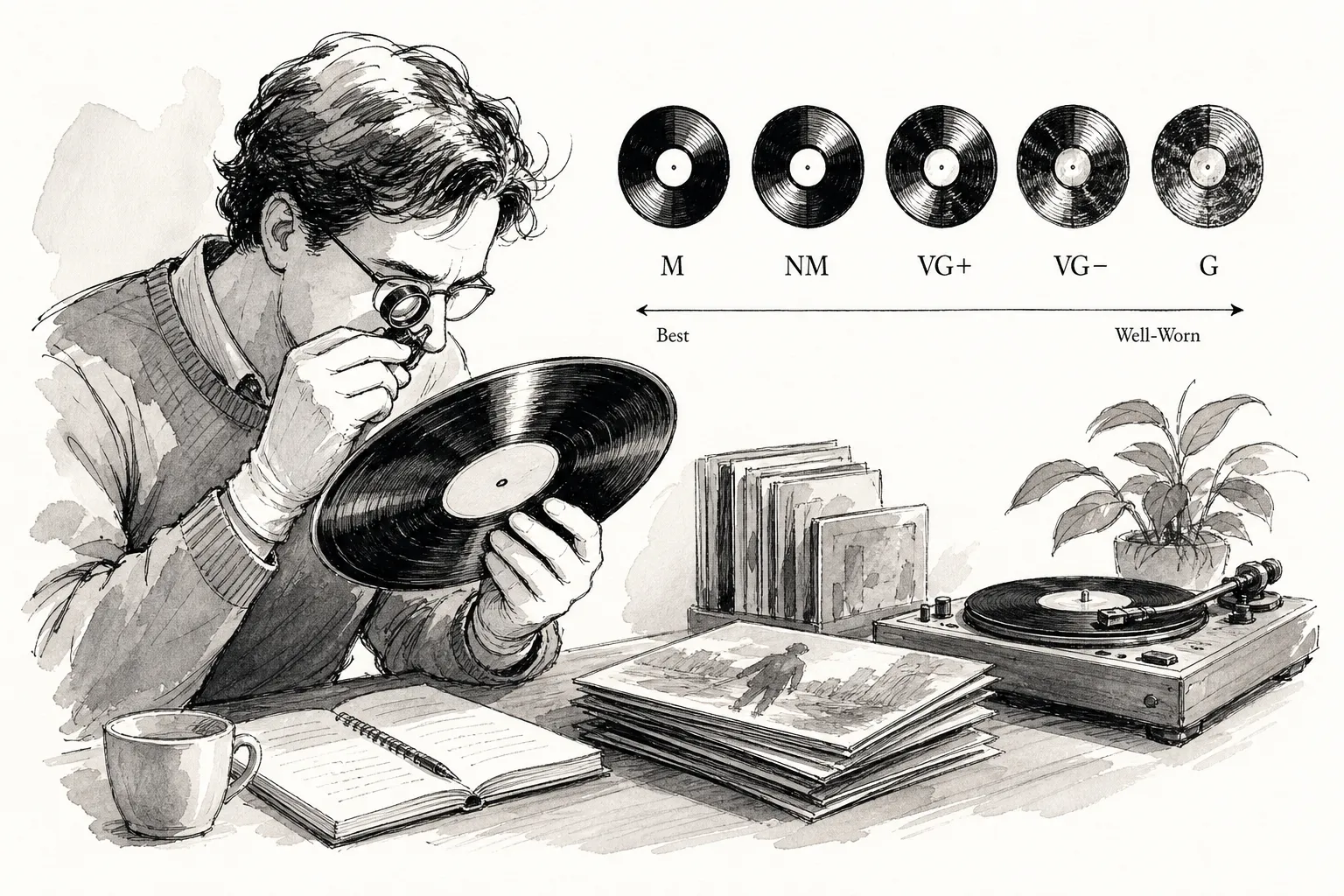
How should I grade the condition of my vinyl records? If you've ever picked up a used record and frozen over a faint line, is that VG+ or does it knock things down to VG?, you already know the feeling. Does a bit of crackle in a quiet intro mean Near Mint is off the table? You start second-guessing everything, and suddenly a fun hobby feels like a pop quiz you didn't study for.
Here's the good news: the grading scale widely used by collectors and sellers is straightforward once you know what to look and listen for. The system is called the Goldmine Standard, and it's been the industry baseline since 1974. Discogs officially adopted the Goldmine Standard, making it the common reference point for collectors and sellers across the platform. Apps like VinylDeck pull your grades into the app automatically, attaching a condition badge right on each record's visual card so your collection stays organized without extra effort. But to get there, you first need to know how to call the grade.
By the end of this, you'll be able to inspect a record under the right light, run a quick play-test, grade the sleeve separately, and assign a confident, consistent condition grade every time.
Why your grade is worth more than you realize
One grade separates a casual deal from a great one
The financial difference between grades is not small. According to the Goldmine Standard's benchmark percentages, a Near Mint record is worth 100% of its market value, a VG+ copy is worth roughly 50%, and a VG copy drops to about 25%. Put that in real numbers: a pressing that sells for $40 in NM condition is worth $20 at VG+ and around $10 at VG. A single grading decision cuts the price in half, twice over. That's why grading carefully matters to buyers and sellers alike, it's the difference between pricing a record fairly and leaving money on the table, or overpaying as the buyer.
The standard collectors rely on: the Goldmine scale
The Goldmine Standard runs from M (Mint) at the top down through NM, VG+, VG, G, and F/P at the bottom. The one rule that trips most beginners up: the record and the sleeve are always graded separately. A record in great shape can come in a sleeve that's been through a lot, and the buyer deserves to know both. You'll often see listings written as VG+/VG, where the first grade is the record and the second is the sleeve. Keep that convention in mind from the start and your listings will be immediately clearer to buyers.
The M to G grading scale explained without jargon
Mint and Near Mint: the gold standard (and why M is almost fictional)
Mint means sealed, unplayed, and factory-fresh. It's so rare that even experienced dealers hesitate to use it. If you're grading a used record, you're almost certainly starting at NM at best. Near Mint is the real top tier: the grooves catch light evenly, the label is spotless, and when you play it, the quiet passages between notes are completely silent. No hairlines visible when you tilt it under a lamp, no marks from handling, no crackle in the intro. Per the Goldmine Standard, NM records should show no obvious signs of wear under bright inspection; minute handling marks may still be acceptable. If you're squinting to decide whether something is even there, you're likely still in NM territory.
VG+ and VG: where most used records actually land
VG+ is the sweet spot of the used market. There may be faint handling marks or a light scuff from sliding in and out of the sleeve, but playback is clean. You won't hear a thing during the quiet parts of a song. This is also the minimum acceptable grade for most serious collectors, and for good reason: VG+ records sound excellent on a well-maintained turntable.
VG steps down noticeably. You'll start to hear it: audible surface noise in soft intros and fadeouts, the occasional light pop, and groove wear that shows as a faint haze in the grooves under strong light. You can sometimes feel light scratches by running a fingertip gently across the surface. VG records still sound great on most tracks, especially in loud passages. The noise just surfaces where the music gets quiet.
Good and Fair/Poor: grade it honestly anyway
A Good record plays through without skipping, but surface noise is a constant companion throughout. Fair and Poor mean cracked, badly warped, or so damaged the needle struggles to track. Grading honestly at these levels still matters. Even G-graded records have collector value when the pressing is rare enough, if you want to dig deeper into determining rarity and its effect on value, see this guide on how to tell if a vinyl record is rare. Buyers who receive a G record described as VG will not come back. Your reputation as a seller is built one accurate grade at a time.
How should I grade the condition of my vinyl records: inspection checklist
The technique that reveals everything (and costs nothing)
Hold the record at a low angle under a single bright light source, nearly parallel to the surface, sometimes called a grazing angle. A desk lamp works perfectly. Rotate the record slowly while keeping the angle consistent. Here's what shows up: hairline scratches appear as faint parallel lines across the surface, deep scratches catch and hold the light, and groove wear shows up as a white or cloudy haze settled into the grooves. Overhead light and diffused room lighting hide most of this. The grazing single source reveals all of it. (Note: if you're photographing records for a listing, diffused lighting or a lightbox reduces glare and produces cleaner images, but for hands-on grading inspection, the low-angle bright lamp is your best tool.)
Matching what you see to a grade
Once you know what to look for, the grade maps fairly directly to what you see. No marks at all under a strong angled light: you're in NM territory. Faint lines that don't catch deeply and disappear when you shift the angle: VG+. Light scratches you can almost feel with a fingertip, plus a visible groove haze in the playing area: VG. Deep scratches that hold the light and obvious surface clouding: G. One useful heuristic to keep in mind: if a mark catches the light and holds it, it will likely affect sound. Marks that only appear briefly as you rotate are generally cosmetic. Marks that stay lit as you rotate will typically translate to noise.
Your step-by-step grading checklist
- Clean the record first, dirt and dust mimic scratches under inspection light.
- Tilt at a low (grazing) angle under a single bright lamp and rotate slowly.
- Note hairlines, scratches, and groove haze, cross-reference with the M, G scale above.
- Run a fingertip gently across the grooves, deep scratches you can feel will affect playback.
- Play the intro and the fadeout, the quietest moments reveal surface noise that loud passages hide.
- Grade the sleeve separately, check for ring wear, seam splits, and any writing or tape.
- Record both grades, media and sleeve.
That checklist is how to grade the condition of your vinyl records consistently, whether you're cataloging a new haul or pricing a record for sale.
The play-test: what your ears confirm that your eyes can't
What to listen for in the first 30 seconds
The intro and fadeout of any track are the most revealing parts of a play-test because the music is at its quietest there. Surface noise hides under loud passages but surfaces immediately in sparse arrangements. NM is dead silent between notes. VG+ has a barely perceptible background hiss that you might only notice if you're specifically listening for it. VG has audible crackle and occasional pops that don't overpower the music but are clearly present. G has persistent noise throughout, from the first groove to the last.
Clicks, warps, and when to downgrade
Specific audible defects each carry their own grading implication. A repetitive click that comes around on every rotation points to a single deep scratch, and that record is VG at best regardless of how it looks visually. A rhythmic thump or low wobble usually means the record is warped and the stylus is riding the warp. Widespread static across the whole side suggests heavy groove wear. A consistent click that repeats every rotation disqualifies a VG+ grade, full stop. The visual inspection gets you close, but the play-test is the only honest final check before you assign a grade for a listing or a catalog entry. For practical tips on reducing audible pops and clicks during recording and playback, this guide on how to avoid pops and clicks in your audio recordings is useful for cleaning and capture techniques that also apply to archival transfers.
Grading the sleeve: the part most collectors overlook
The defects that drop a sleeve grade fast
Three sleeve defects matter most. Ring wear is the circular impression left by the record pressing through the jacket over time; you can see it as a faint or obvious circular outline on the front or back cover. Seam splits happen when the top, bottom, or spine edges of the jacket start to separate. Writing or tape on the cover drops the grade immediately regardless of other condition. NM sleeves have none of these. VG+ may show slight ring wear or a barely turned corner. VG shows visible ring wear and possibly an edge seam split. G has pronounced ring wear and obvious splits, especially along the bottom or spine.
Why sleeve and record grades rarely match (and how to list them)
A VG+ record often lives in a VG sleeve, and that listing should say VG+/VG. The record grade drives the price, but the sleeve grade drives buyer satisfaction. Sellers who accurately grade the record and then underreport sleeve condition generate the most complaints and negative feedback. When you photograph a listing, cover all of it: front, back, all four edges, inner sleeve, and both labels. Don't hide damage. Buyers who see an honest photo of ring wear are prepared for what they'll receive, and that builds trust.
Keeping track of every grade without a spreadsheet
Why physical notes and spreadsheets fall apart fast
You've just graded 30 records, made notes in a notebook, and six weeks later you're staring at two copies of the same pressing wondering which one is NM and which one is VG+. Static record-keeping doesn't scale with a growing collection. It also doesn't travel. You're at a record fair, someone offers you a deal on a pressing you already own, and you have no idea what condition your copy is in without going home to check.
How condition badges make your grades work harder
VinylDeck solves this by attaching a condition badge directly to each record's visual card, right alongside its rarity grade and spin history. When you log a record and set its grade, that information lives on the card permanently. Instead of hunting through a spreadsheet column, you open your card binder and see at a glance which records are NM and which are VG+. You can also spot which ones you've been spinning regardless of condition. It's the same grading work you're already doing after reading this, stored somewhere that makes it useful every time you browse your collection, instead of sitting in a notebook that only gets opened when something goes wrong.
How should I grade the condition of my vinyl records? A quick FAQ
What grading scale should I use?
Use the Goldmine Standard, the same system adopted by Discogs and widely recognized across the collector community. It runs from M (Mint) down through NM, VG+, VG, G, and F/P. For an official how-to on grading items on Discogs, see their How To Grade Items article.
Do I grade the record and sleeve together?
No, always grade them separately and list both, with the record grade first (e.g., VG+/VG). The record and the sleeve can be in very different conditions, and buyers need to know both.
What's the most important thing to check when grading?
The low-angle lamp inspection and the play-test together give you the full picture. The visual check under a bright grazing light reveals scratches and groove wear; the play-test confirms what those marks actually sound like. Neither alone is enough. If you want another clear breakdown of what NM, VG+, VG, and G typically look like, this guide to understanding vinyl record grades is a helpful companion to the Goldmine definitions.
How do I know if a scratch will affect playback?
A useful rule of thumb: marks that only appear briefly as you rotate the record under light are generally cosmetic. Marks that stay lit as you rotate will typically translate to audible noise. A repeated click on every revolution is a reliable sign that one deep scratch has crossed a groove boundary.
A well-graded collection is a collection you actually understand
The first few records you grade will feel slow. You'll hold them under the lamp longer than you need to, second-guess the VG+ call, and re-read the definitions twice. That's normal, and it passes. The tilt-and-rotate inspection becomes familiar quickly, the play-test gets faster, and the sleeve check starts to feel automatic. For a concise reference to the historical Goldmine grading benchmarks and standards, see this overview of the Goldmine grading standard.
The core habit stays simple: tilt under a bright angled light, run your fingertip across the grooves, play the intro and the fadeout, and grade the sleeve separately. Do those four things every time, and your grades will be consistent enough to trust.
Accurate grades protect your credibility as a seller, help you make smarter buying decisions, and give you a clear picture of what you actually own. Knowing how to grade the condition of your vinyl records turns a collection you recognize into a collection you genuinely understand. Start with the record in front of you right now.