

Buying Your First Vinyl Records: A Beginner's Complete Guide
· 12 min read
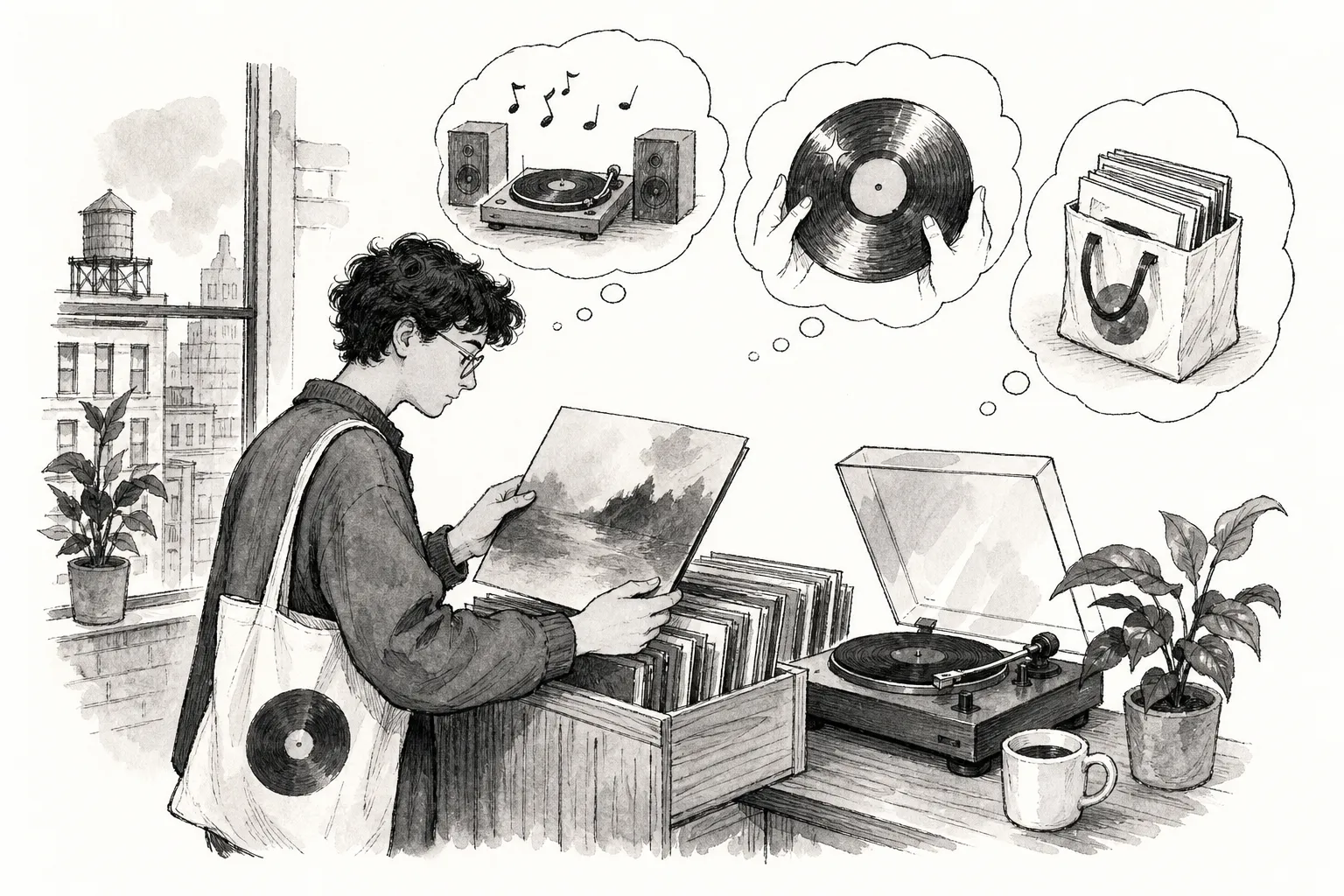
You walk into a record store for the first time. The smell hits you: a mix of cardboard, dust, and something hard to name that just feels like music. You flip through a bin, pull out an album with a cover that catches your eye, and immediately wonder: is this a good one? Is it scratched? Am I about to spend $25 on a record that crackles like a fireplace? The excitement is real. So is the confusion.
If you're asking yourself what should I know before buying my first vinyl records, you're already thinking like a collector. This guide covers the fundamentals every beginner needs: the gear you actually need, how to read condition grades, how to inspect records with your own eyes, where to shop, how to clean and store what you buy, and how to track your collection from day one so it doesn't become a chaotic pile of albums you half-remember.
What Should I Know Before Buying My First Vinyl Records: Turntable and Setup
Before you buy a single record, you need something to play it on. This is where a lot of beginners make their first real mistake: grabbing the cheapest possible option and wondering why everything sounds bad. A poor setup doesn't just sound bad; it can physically damage your records. The good news is that getting a solid beginner rig doesn't require spending a fortune.
What turntable should a beginner actually buy?
Two names come up constantly for good reason. The Audio-Technica AT-LP60X sits in the $150 to $250 range, runs fully automatic (meaning the tonearm lifts at the end of a side), and includes a built-in phono preamp. It's the easiest "plug in and play" option available. The Fluance RT85 costs around $300 and comes bundled with an Ortofon Blue cartridge, which alone usually costs $150 to upgrade. It's a belt-drive manual turntable, and many listeners find it a clear step up in sound quality over the AT-LP60X for the price. Both are real, quality machines. Neither will eat your records.
The turntables to avoid are the cheap suitcase-style portable players. They look charming but use low-quality needles with incorrect tracking weight, which physically grinds away at your grooves over time. Experts consistently warn that these players cause significantly accelerated wear, skip them entirely and put that money toward a proper setup instead.
Speakers, preamps, and the setup that actually works
The simplest path for most beginners is a pair of powered speakers, which have amplifiers built in. That means you plug the turntable directly into the speakers and you're done, no separate receiver or extra boxes required. The Edifier R1280DB runs around $190 and is a strong performer at that price point. If you want a step up, the Audioengine A2+ at $279 is a compact, clear-sounding pair that fits well in smaller rooms. For curated recommendations and options by use case, see a guide to best powered speakers for your turntable setup.
One thing to check before you buy: if your turntable doesn't have a built-in phono preamp, you'll need an external one. The phono preamp boosts the signal from the cartridge to a level your speakers can actually use. The AT-LP60X includes one built in; the Fluance RT85 does not. A decent entry-level external preamp typically adds anywhere from $30 to $150 or more to your budget depending on the model, and setup takes about two minutes. When you add it all up, a solid beginner setup in 2026 costs $500 to $700 total. That number stings a little, but it buys you a system that won't damage your records or make good music sound flat.
Reading Vinyl Condition Grades Before You Shop
Condition grades are the shorthand sellers use to describe the physical state of a record. They affect both how the record sounds and what it's worth. Getting comfortable with them before you start shopping is one of the most important things to know before buying your first vinyl records, it prevents you from paying too much for too little.
What NM, VG+, VG, and G actually sound like
NM (Near Mint) plays like a brand-new record. No background hiss, no clicks, nothing but music. It commands the highest prices because it offers the best listening experience and the strongest resale value. VG+ (Very Good Plus) is nearly as good and typically priced at around 50% of an NM copy. Minor hairline scuffs may exist but don't significantly affect playback. For value-conscious beginners, VG+ is the sweet spot.
VG (Very Good) has audible surface noise, especially during quiet passages or song intros. Background hiss is present. The music is still there and enjoyable, but the noise is real. VG copies usually sell for about 25% of NM value. G (Good) and below are bargain-bin territory for a reason: you'll hear the wear on every track. Those grades are fine for artwork or decoration, but they're rough listening. For a deeper dive into grading conventions and their real-world meaning, read an understanding vinyl record grades guide.
How condition grades affect price (and when a "bargain" isn't one)
The price curve drops fast: NM at full value, VG+ at roughly half, VG at a quarter, G and Fair approaching negligible. The common rookie mistake is paying VG+ prices for a record that's actually VG. This happens all the time when sellers grade their own records, because sellers tend to be generous with themselves. If you're buying online, always ask for recent photos of the actual disc, not the stock image from the catalog.
What Should I Know Before Buying My First Vinyl Records, Grading and Inspection
A grade on a sticker is only as reliable as the person who wrote it. Learning to check a record yourself takes about two minutes per disc and saves you from a lot of disappointment. The inspection process breaks down into two parts: reading the playing surface and reading the sleeve.
The light-angle trick for spotting scratches
Hold the record up to a bright light source and slowly rotate it so the light wraps across the playing surface. You're looking for scratches that run diagonal to the grooves. Those are the dangerous ones: they cross multiple grooves at once and cause skips. Surface scuffs that run parallel to the grooves usually don't affect playback. Once you spot something that looks significant, run your fingernail lightly over it. If you feel the scratch catch, you'll hear it during playback.
Checking for warps and sleeve damage
Hold the record horizontally at eye level and look across the surface from edge to edge. The edge and the center label should sit on the same plane. If one side dips lower or rises higher, the record is warped. A warped record creates a rhythmic "wobble" in the sound as it spins and can skip depending on severity. Rotate it 90 degrees and check again to confirm.
For the sleeve, inspect the seams at the 9 o'clock and 3 o'clock positions. Intact seams suggest the record lived a relatively easy life. A completely split seam, a missing inner sleeve, or a damaged paper inner sleeve often signals a disc that's seen rough use. If you're shopping at a physical store, the best possible test is asking if you can hear the record before buying. A shop that trusts its grading will say yes.
Where to Find Your First Records (and What to Watch Out For)
Once you know what you're looking for, you need to know where to look. Each source has real advantages and specific traps for beginners.
Local record stores and record fairs: the hands-on advantage
Starting local is the best move for your first purchases. You can inspect every record physically before money changes hands, staff at good shops know their stock and can guide beginners toward solid finds, and you support the community that keeps this hobby alive. Record fairs add another layer: multiple dealers in one place means more variety and, often, the ability to negotiate prices. The one risk with both is that dealers occasionally overgrade, which is exactly why the inspection skills above matter.
Discogs, eBay, and thrift stores: what to know before clicking "buy"
Discogs is the most trusted online source for used vinyl. Its catalog covers nearly every pressing ever made, price history tells you what records have actually sold for, and the seller feedback system creates real accountability. Even so, sellers misgrade on Discogs, so always request recent photos of the actual disc before buying anything in VG condition or below. eBay is useful for hunting specific rare pressings but carries higher condition risk than Discogs because the seller base is less specialized.
Thrift stores offer the lowest prices and the highest variance in the hobby. You might pull a near-pristine classic out of a 50-cent bin. You might pull a warped and scratched mess. Thrift stores are the right place to practice your inspection skills, but they're not where you want to build the core of your collection when you're just starting out. For recommended retail and online sources, see a roundup on where to buy vinyl records.
Cleaning and Storing Records to Protect Your Investment
Even a well-graded used record picks up dust, fingerprints, and residue from paper inner sleeves over the years. Cleaning before the first play is a habit worth building immediately.
The right way to clean a new-to-you record
Every cleaning session starts dry. Use a carbon fiber brush to sweep loose dust from the surface before any liquid touches the record. Skipping this step and going straight to wet cleaning traps dust in your cleaning solution and pushes it deeper into the grooves. After the dry pass, apply a vinyl-safe cleaning solution and spread it with a velvet pad or soft microfiber cloth, always moving in the direction of the grooves, never across them.
The Spin-Clean and GrooveWasher kits are both solid starting points in the under-$50 range and handle the process cleanly, check current pricing before you buy, since costs shift. If you want to mix your own solution, a safe ratio is 75 to 80% distilled water, 20 to 25% isopropyl alcohol at 90% or higher, and a trace of surfactant. Never use tap water; the minerals leave residue. Let the record dry completely before playing. For step-by-step care, read a vinyl cleaning, restoration, and storage guide.
Storage basics that keep your collection playback-ready
Store records vertically, like books on a shelf. Flat-stacking causes warping over time as the weight of records above presses down on those below. Replace paper inner sleeves with poly inners; paper sheds microscopic fibers directly into the grooves with every insertion and removal. Keep records away from heat sources and direct sunlight, both of which are among the fastest ways to cause warping. These habits cost almost nothing and can significantly extend the usable life of your collection.
Building and Tracking Your Collection from Day One
Most beginners tell themselves they'll start logging their collection "later." Later becomes never, and suddenly you own 80 records and can't remember which pressing of a particular album you have, whether you've played it recently, or what you paid for it. Start tracking from record one.
Why logging your records matters more than you think
A log prevents duplicate purchases, which happen more often than you'd expect once a collection grows to a few dozen records. It also shows you which albums you actually play versus which ones have been sitting untouched for months. That listening pattern tells you a lot about your real taste versus your aspirational taste, and it points you toward records you forgot you loved.
How VinylDeck turns your collection into something worth exploring
One tool worth knowing about from the start is VinylDeck, your vinyl collection, graded like a card deck, a free web app built specifically for this part of the journey. If you already have records logged on Discogs, it's designed to pull in your library without requiring manual data entry for every album. Each record is displayed as a collectible card showing rarity information drawn from Discogs demand data, giving you a sense of whether that pressing you just bought is common or harder to find. Learn more about rarity in How to tell if a vinyl record is rare (and what it's actually worth) · VinylDeck.
VinylDeck also includes a gamified achievement system with collector rank titles that give beginners concrete, motivating checkpoints as they build and spin. For a beginner, seeing your progress laid out visually makes the hobby feel like something you're genuinely advancing through. Visit VinylDeck's site directly to confirm current pricing, sign-up details, and the full feature set, it's the kind of tool you'll wish you'd started using on day one.
Start Small, Start Smart
Vinyl collecting rewards patience and curiosity far more than it rewards spending a lot of money fast. The collectors with the best collections built them one well-chosen record at a time. So what should you know before buying your first vinyl records? Start here: a solid turntable setup, a clear understanding of condition grades, the ability to inspect a record before you hand over cash, a few trusted shopping sources, and a cleaning routine. Those five things put you ahead of where most people start.
Begin with five to ten records you genuinely love rather than a crate of unknowns from a thrift store, and you'll build a collection you actually want to listen to. Every record has a story, and keeping track of those stories from the very beginning makes the whole thing more satisfying. Log your first record in VinylDeck, watch it flip into a card, and see what it pulls up. That's as good a place to start as any.